
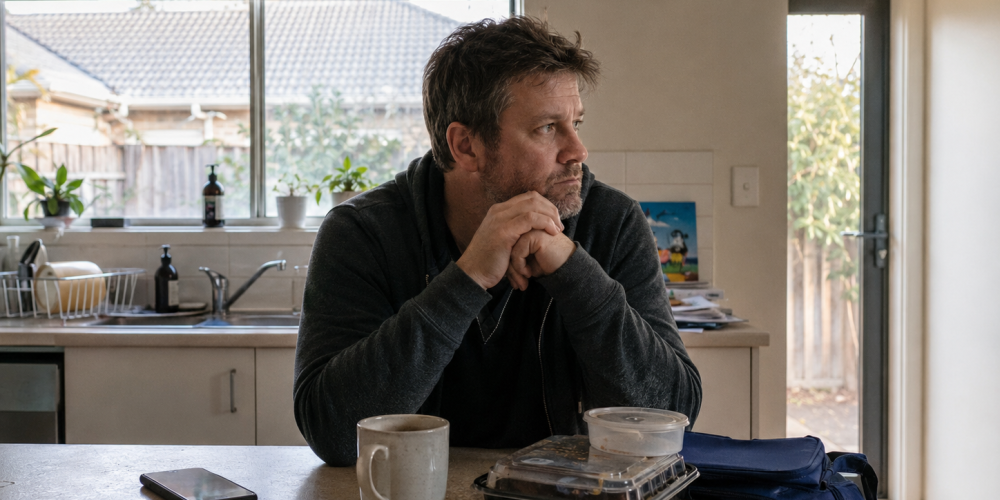
It usually starts with a perfectly reasonable excuse.
A rough week. A sick kid. Work blows out. The weather is miserable. Sleep goes sideways. Dinner becomes whatever is easiest because nobody thought about it until 7:15pm.
Fair enough.
Then somehow it’s six or eight weeks later and the “temporary” version of life is still running the show.
Walking shoes haven’t moved from the same spot. Takeaway is happening a little more often. Bedtime has drifted later because the couch is finally quiet. Lunch is whatever can be grabbed between things. Maybe the weekend drinks have crept up too.
Nothing dramatic happened.
That’s why it’s hard to notice.
Survival mode can quietly become a routine without anyone actually deciding to give up.
And late winter is very good at this.
By August in Melbourne, the cold mornings aren’t new anymore. The novelty of soup and trackies disappeared about two months ago. It gets dark early, everyone seems to have had some sort of cough since May, and getting outside can feel like another job on the list.
So standards slide a little.
Not because anyone suddenly stopped caring.
Life just kept going.
This is the sneaky bit about winter habit drift. A lot of people aren’t sitting there thinking, “Stuff it, I’m done looking after myself.”
They’re still getting everyone where they need to be. Still working. Still sorting dinner. Still remembering the school thing that was apparently mentioned once in an email three weeks ago.
They’re functioning.
Sort of.
And when life is already full, the habits that make life easier long term are often the first ones quietly pushed aside.
What Most Advice Gets Wrong
Most health advice treats this moment like somebody needs a kick up the backside.
Set some goals. Get organised. Meal prep Sunday. Exercise four times this week. Stop making excuses.
Yeah. Great.
Except the person hearing that might already be barely keeping the household upright.
Adding another giant list of things they’re doing badly usually helps enormously.
Obviously not.
People keep mistaking exhaustion for a lack of discipline.
There’s a difference.
Someone can care about their health and still find themselves eating toast for dinner twice in a week because cooking feels like too much effort.
Someone can genuinely want to exercise and still look at the cold garage at 6am and think, nah.
Someone can know they need more sleep and still stay awake scrolling until 11:45 because it’s the first hour all day where nobody wants anything from them.
That stuff counts.
Not as failure. Just information.
Why Stress Starts Showing Up On Your Body Even When You’re “Trying”
The usual response is to wait until there’s enough frustration to justify a big reset.
Monday.
Next month.
When work settles down.
When the weather improves.
When there’s finally some energy again.
But there doesn’t need to be a dramatic moment where everything changes.
Actually, waiting for that moment is often what allows another month to disappear.
What’s Actually Happening Beneath The Surface
When people stay in survival mode for a while, the brain starts choosing convenience more often.
That isn’t some deep character flaw. It’s fairly practical.
Poor sleep can make hunger and cravings harder to manage. Stress makes easy decisions more attractive. Decision fatigue means nobody feels particularly excited about chopping vegetables at the end of a twelve-hour day.
So the supermarket trolley changes a bit.
Dinner changes.
Movement drops because sitting down sounds much better.
Then sitting down turns into scrolling because the brain still hasn’t properly switched off.
And suddenly bedtime is later again.
It gets messy.
The longer people run on empty, the more “good enough for tonight” starts becoming normal.
I’ve had people look at their week and genuinely say their food hasn’t changed much. Then we start talking through Tuesday. No breakfast because everyone was late, a couple of biscuits at work, kids’ leftovers while cleaning the kitchen, takeaway because nothing had been defrosted. Wednesday was different, but not really. Thursday wasn’t much better.
Nobody was smashing family-sized pizzas alone in a dark room.
Life had just become a bit scrappy.
That distinction matters.
Because when people think the problem is that they’ve completely lost control, they usually respond with something far harsher than the situation actually requires.
They start cutting things out.
Planning an unrealistic training week.
Promising no alcohol.
No takeaway.
No snacks.
Perfect lunches.
Eight hours of sleep every night somehow.
By Wednesday the whole operation is hanging by a thread.
This is why recognising winter habit drift early matters more than trying to punish it later.
Look around a normal day before looking for a new diet.
What time are meals actually happening?
Has walking disappeared?
Are evenings mostly recovery-by-couch now?
Is bedtime later than it was a few months ago?
Has takeaway gone from once a week to three times without really being noticed?
Is Sunday being spent trying to recover from Saturday while also catching up on washing, groceries, school stuff and work?
There it is.
No moral judgement required.
How To Become Someone Who Does Not Quit
Sometimes the habit that slipped first isn’t even food or exercise.
Sleep went first.
Or work boundaries.
Or getting outside.
Then everything else became harder.
A lot of adults are trying to solve the fourth problem while completely ignoring the first one.
Eventually the body just goes nah.
The Hard Truth
There’s no need to turn this into another reason to beat yourself up. But pretending nothing has changed because life has been hard doesn’t help either.
You do not need to earn your way back with a perfect week.
Being overwhelmed explains the drift; it does not mean you have to keep living inside it.
Guilt is not a plan, and one messy day does not mean the whole week is gone.
Practical Shifts That Make This Easier
Start smaller than the frustrated version of you wants to.
That version wants twelve new rules by Monday morning.
Ignore them.
The goal is not a dramatic reset; it is to notice what has quietly stopped happening.
Pick through the last couple of months.
Not every habit. Just the obvious ones.
Maybe dinners used to be planned three nights ahead and now they’re decided while standing in front of the fridge.
Maybe there was a regular Saturday walk that disappeared once the weather turned.
Maybe lights-out used to be around 10:30 and now Netflix keeps winning until midnight.
Maybe lunch has become coffee plus random things eaten while working.
Choose the habit creating the most knock-on mess.
That’s usually a better place to start than choosing the habit carrying the most guilt.
If sleep is awful, pushing harder in training might not be first.
If food organisation has disappeared, getting groceries sorted might make more difference this week than banning chocolate.
If movement has dropped away completely, a twenty-minute walk after work might be useful before worrying about some elaborate six-day exercise schedule.
Boring?
A little.
Useful?
Very.
And make the environment do some of the work.
Put the walking shoes somewhere they’ll actually be seen.
Get two easy dinners into the house before the week begins.
Charge the phone outside the bedroom if late-night scrolling is becoming ridiculous.
Book the training session instead of relying on Wednesday-night enthusiasm to magically appear.
People love trying to solve everything with willpower.
Willpower is often asleep on the couch by 8:40pm.
A smaller habit that survives a bad week is worth more than a perfect plan that only works when life behaves itself.
There also needs to be some allowance for the fact that winter is winter.
Nobody needs to pretend a freezing dark morning feels exactly like a bright October one.
The expectation can change without disappearing altogether.
That could mean two training sessions instead of four for a while.
Shorter walks.
Simpler meals.
Earlier nights.
A little less pressure around doing everything brilliantly.
Not zero standards.
Just standards that fit the actual season of life.
For some people, working out what has slipped is harder than fixing it.
Everything feels vaguely off, but it’s hard to see where to begin because every problem seems connected to another one.
That’s where outside accountability can be useful.
Bailey’s Bodies Fitness can help untangle that through practical coaching and At-Home Coaching support — looking at what is actually happening across food, movement, sleep, stress and the week itself, then finding a realistic place to restart.
Not a punishment plan.
Not “new you” nonsense.
Just some structure again.
Because a few rough weeks turning into a rough few months doesn’t require panic.
It needs noticing.
Maybe one or two things get tightened up this week.
Maybe bedtime comes forward.
Maybe groceries happen before everyone is starving.
Maybe the shoes finally get used again.
And weirdly, that can be enough to make life feel slightly less chaotic.
The concerning part was never that winter got messy.
It’s how easy it became to stop noticing that this wasn’t how things used to be.